Does a Sauna Burn Calories? The Honest Answer
Step on a scale after twenty minutes in a sauna and the number drops. It is tempting to read that as calories burned. The sweat, the raised pulse and the flushed skin all feel like work. So the question comes up constantly, usually from someone who would rather sit in warm steam than run on a treadmill: does a sauna burn calories, and how many?
The direct answer: a little, and far less than the scale suggests. Sitting in a sauna raises your heart rate and your body works to stay cool, which burns somewhat more than sitting on the couch, roughly in the range of a slow walk. The pound or two that disappears is water, and it comes back with the first bottle you drink. This guide gives the honest numbers for 10, 20 and 30 minutes, explains where the weight actually goes, compares steam, dry and infrared rooms, and lays out what a steam sauna is genuinely good for, which is a lot, just not weight loss.
The short answer: a few extra calories, not a workout
A sauna burns calories the way any raised body temperature does: the heart beats faster, blood moves to the skin, sweat glands work, and all of that takes energy. Published estimates put the burn at roughly one and a half to two times your resting rate while you are in the heat. For most adults that means something in the range of 20 to 40 calories in a 15 minute session beyond what you would have burned sitting still.
That is not nothing, but it is not a workout either. A 30 minute brisk walk burns several times as much, and a 30 minute sauna cannot be stacked the way walks can, because the body cannot handle hours of heat. The honest frame is that a sauna is a recovery tool with a small calorie side effect, not a calorie tool with a recovery side effect.
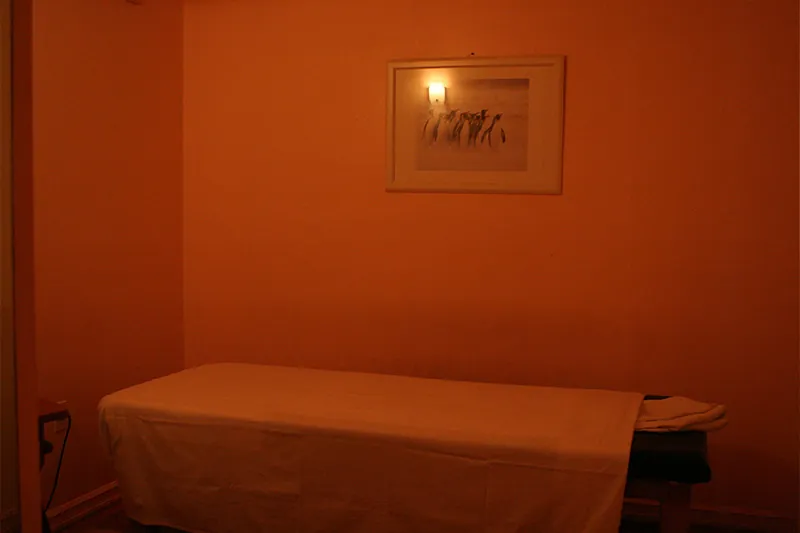
205 Spa has a steam sauna, and the people who use it well treat it that way. It warms muscle before a massage, softens skin before the table shower and settles the nervous system after a long shift. The steam sauna page describes how it fits into a visit. None of that is about the scale.
What is actually happening in your body
Heat forces the body to defend its core temperature, and that defense is the whole source of the extra burn. Three things happen at once.
Heart rate and circulation
Within a few minutes in a hot room, the heart rate climbs. Blood vessels in the skin widen to move heat to the surface, and the heart pumps harder to keep pressure up while that happens. A small 2019 German study measured heart rate and blood pressure during a sauna and found responses similar to light to moderate exercise, which is where the comparison to a slow walk comes from. The muscles themselves are doing nothing, which is the difference from a real walk.
Sweating and fluid loss
Sweat is the body's cooling system, and in a hot room it runs flat out. In a dry sauna the sweat evaporates and does its job. In a steam room, where the air is already saturated, sweat pours off without evaporating, so the body keeps producing more. Either way the weight lost is almost entirely water, which the next section covers.
Heat adaptation and brown fat
Regular sauna users adapt. They start sweating sooner, tolerate the heat longer and recover faster. Some researchers have asked whether repeated heat exposure changes metabolism or activates brown fat, the tissue that burns energy to make heat. Cold exposure has decent evidence for brown fat activation. For heat, the evidence is thin, and no one should count on it. Treat it as an open question, not a feature.
Calories burned in 10, 20 and 30 minutes
Here are rough figures for an average adult, using the common estimate of one and a half to two times resting burn. Resting burn itself varies with body size, age and sex, so treat the numbers as a range, not a promise. The walk column is there for scale.
| Time in the sauna | Sitting still | In a sauna | Brisk walk, same time |
|---|---|---|---|
| 10 minutes | 12 to 15 calories | 18 to 30 calories | 40 to 60 calories |
| 20 minutes | 24 to 30 calories | 36 to 60 calories | 80 to 120 calories |
| 30 minutes | 36 to 45 calories | 54 to 90 calories | 120 to 180 calories |
Two things stand out. The extra burn from the sauna, the gap between the second and third columns, is 6 to 45 calories depending on the session. That is less than a banana. And the walk column keeps rising with time in a way the sauna column cannot, because 30 minutes is already near the upper limit most people should spend in heat without a break.
Larger people burn more in every column. Someone who weighs more has more tissue to heat and more surface to cool, so their sauna burn runs toward the top of each range. Fitter people often burn slightly less, because their bodies cool more efficiently. Neither effect changes the conclusion.
The weight you lose is water
The drop on the scale after a sauna is sweat, full stop. A hard 20 to 30 minute session can pull a pound or more of water out of the body, and every ounce of it belongs back inside you. The first bottle of water afterward restores most of it, and a normal day of eating and drinking restores the rest.
Burning a pound of fat takes a deficit of roughly 3,500 calories. At 30 extra calories per sauna session, that is over a hundred sessions for a single pound, and that is before accounting for the water you drink back. Nobody is losing fat in a sauna. People who use saunas for weight cutting before a weigh in, like wrestlers and fighters, are cutting water on purpose and putting it back on hours later, and they will tell you it feels terrible.
The practical point for a spa visit is the opposite of weight loss. Drink before, drink after, and do not try to extend the session by skipping water. Every session at 205 Spa ends with time to rest and rehydrate for exactly this reason. Walking out of a steam room a pound lighter and lightheaded is not a win.
Steam sauna vs dry sauna vs infrared: does the type matter?
For calorie burn, not much. All three raise core temperature, and the body's response is similar. Marketing for infrared cabins sometimes claims far higher burn figures. Those numbers come from small or industry funded sources and have not held up well. Here is how the three compare on the measures that do differ.
- Steam sauna. Around 110 to 120 degrees Fahrenheit with humidity near 100 percent. Feels hottest for its temperature because sweat cannot evaporate. Sessions run 10 to 15 minutes. Best for skin, breathing and warming up before bodywork.
- Dry sauna. Around 150 to 195 degrees with low humidity. Sweat evaporates, so sessions can run 15 to 20 minutes. The most studied type for heart health, mostly through long Finnish population studies.
- Infrared cabin. Around 120 to 140 degrees with dry air, heating the body directly with infrared light. Sessions often run 20 to 30 minutes because the air is milder. Mostly found in homes and wellness studios.
The post on steam sauna vs dry sauna goes into the first two in detail, and the guide to infrared vs steam sauna covers the third. For the purpose of this question, pick the room you enjoy. The calories will be about the same, and enjoyment is what gets you back in the door.
What a sauna is actually good for
Set the calorie question aside and the case for a steam sauna is strong. The benefits that hold up are about recovery, relaxation and skin, not the scale. Published research supports most of the following at least modestly, and plenty of people would add their own.
Muscle recovery and stiffness
Heat raises the temperature of muscle and connective tissue, which eases stiffness and makes stretching and massage more effective. Studies on sauna use after exercise report less perceived soreness. Athletes have used heat for recovery for a long time, and a steam room before a sports massage is a sensible pairing for the same reason.
Relaxation and sleep
Fifteen minutes in warm steam with nothing to do is one of the few places left where a phone does not work. The heart rate rises in the heat and then drops below baseline afterward, and many people sleep better the night of a session. For shift workers coming off nights, that drop is often the main reason they come.
Skin
Steam opens pores, softens the outer layer of skin and leaves it hydrated rather than dried out, which a dry sauna does not. That is why the steam sauna at 205 Spa pairs with the table shower, where the therapist works an exfoliating cloth across skin the steam has already softened.
Breathing
Warm, moist air eases a stuffy head and tight chest for a while. It does not cure anything, but people with seasonal congestion often feel clearer after a steam session, and that comfort is real even if it is temporary.
Heart health, with a caveat
Large Finnish studies have linked frequent dry sauna use to lower rates of cardiovascular problems over many years. Those are observational studies of dry saunas in a population where sauna is a lifelong habit, so they do not prove cause and they do not transfer neatly to a steam room in New Jersey. Still, the direction is encouraging for anyone who enjoys heat and has no reason to avoid it.
Precautions, and who should skip the heat
Heat is safe for most healthy adults in short rounds, and risky for a few. As general guidance, ask a doctor before using a sauna or steam room if you have heart disease, uncontrolled high blood pressure, low blood pressure that makes you faint, or if you are pregnant. Anyone with a condition that affects sweating or fluid balance, including some diabetes medications, should ask too.
For everyone, a few rules keep a session on the right side of the line.
- Drink a full glass of water before you go in and another when you come out.
- Keep a steam session to 10 to 15 minutes, and a first session shorter than that.
- Skip heat after alcohol, with a fever, when dehydrated, or right after a heavy meal.
- Get out at the first sign of dizziness, nausea or a pounding heart. Sit, drink, and do not go back in.
- Never use heat to lose weight for an event. The weight is water, and the dizziness is real.
Chasing calories is the most common way people turn a safe habit into an unsafe one. Longer sessions, hotter rooms and skipped water all push toward dehydration and heat illness for a calorie payoff that would not cover a slice of bread. Use the heat for what it does well and let the gym handle the rest.
Using the steam sauna at 205 Spa the right way
At 205 Spa the steam sauna is one of 14 services and it works best as a first step. A typical visit runs steam for 10 to 15 minutes, water and a short cool down, the table shower, then whichever massage you came for, then rest. The services page lists every massage that can follow the steam, from Swedish to deep tissue to hot stone.
The hours make it easy to fit in. The spa is open every day from 9 AM to 11 PM, which covers the after work crowd coming off Route 80, Route 17 and Route 46, and the shift workers who want steam and a massage at 9 in the morning after a night on their feet. Walk ins are welcome, so a session does not need to be planned days ahead. If you do want a room held, a quick call does it.
If you exercise, the best pairing is heat after the workout rather than instead of it. Train, come in, steam for ten minutes to settle the muscles, and let the massage handle the knots. That routine supports the training. A sauna alone, used as a shortcut around it, supports nothing but the water bill.
Visit 205 Spa in Saddle Brook
205 Spa is at 205 N 6th St in Saddle Brook, between Midland Avenue and Market Street. It is open every day from 9 AM to 11 PM. Walk ins are welcome, or call 201-368-5244 to hold a room. There is free parking on site. The full list of services shows the steam sauna, the table shower and every massage that can follow them.
Questions readers ask
Does sweating more mean I burned more calories?
No. Sweat volume reflects how hard the body is working to cool down and how humid the room is, not how much energy it spent. A steam room produces a lot of sweat at a modest calorie cost.
Does a sauna after a workout burn extra fat?
Not meaningfully. It adds a small number of calories and helps the muscles recover, which is a better reason to use it. Any fat loss comes from the training and the food, not the heat.
How much water should I drink after a steam sauna?
At least a full glass right away, and keep drinking through the evening. A 15 to 20 minute session can pull a pound of water out of the body, and all of it needs to go back.
Is it safe to use a steam sauna every day?
Many healthy adults do, in short rounds of 10 to 15 minutes with water before and after. Anyone with heart or blood pressure concerns, or who is pregnant, should ask a doctor about frequency first.